



Can you take a power bank on a plane? Yes, but only in your carry-on and only if it stays within the watt-hour limit. The rules also got stricter in 2026: you can now bring no more than two power banks, and recharging one on board is prohibited. This guide explains the rules, shows you how to convert mAh to Wh and covers what to expect on KLM, Lufthansa and TUI fly.
Good to know: this is a practical overview, not legal advice. The rules were checked on 14 November 2026 against the sources listed at the end. Airlines can be stricter than the international rules, so always check your own airline's website before you fly.
The short answer: carry-on only, never in checked baggage
A power bank is a loose lithium battery, and aviation rules treat it as a spare battery. That leads to three basic rules:
- Carry-on only. A power bank must never go in checked baggage. Nobody can step in if a battery overheats in the hold, but the crew can in the cabin.
- Up to and including 100 Wh needs no approval. Almost every ordinary power bank falls under this limit.
- No more than two power banks per person. This international limit has applied since 27 March 2026.
Is your cabin bag taken at the gate and put in the hold because the overhead lockers are full? Take your power bank out first and keep it with you in the cabin.
The Wh limit: what is and is not allowed?
For air travel, the capacity of a power bank is expressed in watt-hours (Wh). You will usually find the figure printed on the casing or in the manual. The table shows what applies to each category.
| Capacity | Carry-on | Checked baggage | Notes |
|---|---|---|---|
| Up to and including 100 Wh | Yes, maximum of 2 power banks per person | No | No approval needed |
| More than 100 Wh, up to and including 160 Wh | In 2026 only with prior approval from the airline | No | IATA already advises airlines to refuse this category. From 1 January 2027, the IATA rules no longer allow power banks above 100 Wh |
| More than 160 Wh | No | No | Not allowed as passenger baggage |
Our advice: buy a power bank of 100 Wh or less for travel. That keeps you within the rules now and after the 2027 change.
How to convert mAh to Wh
Many power banks show their capacity in large print in mAh and in small print, or not at all, in Wh. The conversion is simple:
Wh = mAh x V / 1000
V is the nominal voltage of the battery cells. For lithium-ion that is typically 3.7 V. A 20,000 mAh power bank therefore works out at 20,000 x 3.7 / 1000 = 74 Wh.
| Capacity in mAh | Calculation at 3.7 V | Capacity in Wh | Allowed in carry-on? |
|---|---|---|---|
| 5,000 mAh | 5,000 x 3.7 / 1000 | 18.5 Wh | Yes |
| 10,000 mAh | 10,000 x 3.7 / 1000 | 37 Wh | Yes |
| 20,000 mAh | 20,000 x 3.7 / 1000 | 74 Wh | Yes |
| 27,000 mAh | 27,000 x 3.7 / 1000 | 99.9 Wh | Yes, just under the limit |
| 30,000 mAh | 30,000 x 3.7 / 1000 | 111 Wh | Only with approval, and not at all from 2027 |
| 50,000 mAh | 50,000 x 3.7 / 1000 | 185 Wh | No |
Keep in mind that the calculation is only a guide. The Wh rating printed on the product by the manufacturer is what counts. KLM, for example, states that you may not be allowed to bring a power bank if its capacity in Wh is not shown on it. So check that the label is readable before you travel.
New in 2026: two at most, and no recharging on board
The International Civil Aviation Organization (ICAO) tightened the rules for power banks on 27 March 2026. Here is what changed:
- A maximum of two power banks per passenger.
- A power bank must not be recharged on board, so not from the socket or USB port at your seat.
- The advice is not to use it to charge other devices on board either. Internationally this is a recommendation, but more and more airlines are turning it into a ban.
- Protect the power bank against short circuits when it is not in use, for example in a pouch or a separate pocket of your bag.
- Preferably do not store it in the overhead locker. Keep it within reach, so you notice straight away if it gets warm.
How quickly each country adopts these rules in its own legislation varies. In practice, the major airlines already follow them.
Differences between airlines
Airlines can be stricter than the international rules. Here are three examples we confirmed on the airline's own website:
- KLM: a maximum of 2 power banks, each 100 Wh or less. You keep the power bank with you and you are not allowed to use or charge it on board. Batteries above 160 Wh are never allowed.
- Lufthansa Group (including Lufthansa and Eurowings): since 15 January 2026 you may neither use nor charge a power bank on board. A maximum of 2, stored in the seat pocket, on your person or in the bag under your seat, so not in the overhead compartment. Between 100 and 160 Wh you need approval in advance.
- TUI fly (Netherlands): a maximum of 2 power banks of no more than 100 Wh each. Keep them with you and do not use or charge them during the flight.
Flying with another airline, such as Transavia, Ryanair or easyJet? Search their website for "dangerous goods" or "lithium batteries". These rules are being updated regularly at the moment.
Example: can you take a 20,000 mAh power bank on a plane?
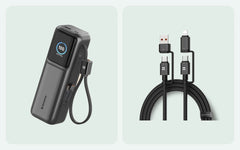
Yes. At 3.7 V, a 20,000 mAh power bank has a capacity of 74 Wh, comfortably below the 100 Wh limit. The same goes for our PowerPack PRO: 20,000 mAh, 74 Wh. It can go in your carry-on, but like any other power bank it cannot go in a checked suitcase. And on airlines such as KLM and Lufthansa you cannot use it during the flight. So charge your laptop and phone before boarding, for example in the departure hall or on the train to the airport.
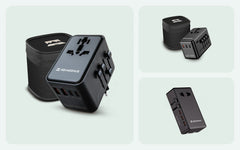
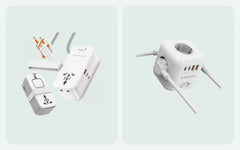
Travelling outside Europe usually means a different type of socket at your destination. A world travel adapter lets you recharge your power bank and other devices there too. Our complete guide to world travel adapters explains which plug you need where.
Checklist before you leave
- Check that the Wh rating is printed on your power bank and that it is 100 Wh or lower.
- Bring no more than two power banks per person.
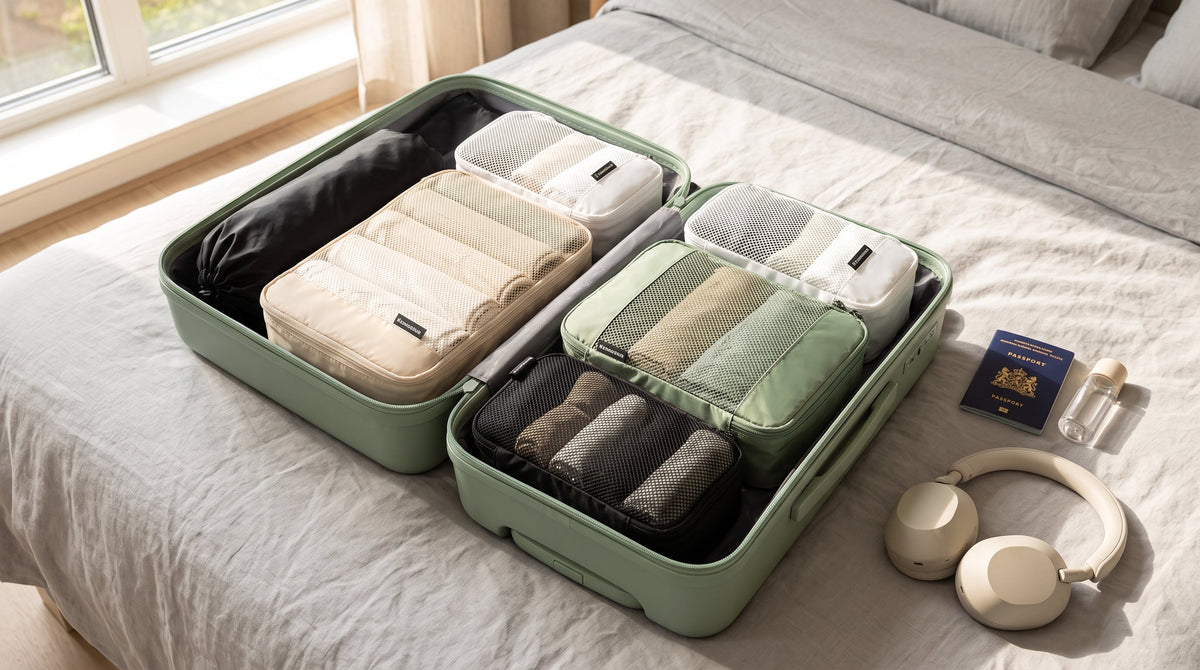
- Pack the power bank in your carry-on, ideally in the bag that goes under the seat.
- Protect the ports, for example with a pouch.
- Do not travel with a damaged, dented or swollen power bank.
- Charge your devices before the flight.
- Check the current rules on your airline's website.
For more tips on travelling with carry-on only, read Pack Smart With Only Carry-On Luggage: 12 Tips. Want to know how big your bag can be? See our overview of carry-on sizes by airline.
Frequently asked questions
Can a power bank go in checked baggage?
No. Power banks and spare lithium batteries are allowed in carry-on baggage only. This applies on every airline.
How many power banks can you take on a plane?
Since 27 March 2026 there has been an international maximum of two power banks per person. An airline can set a lower number, so check in advance.
Can you take a 20,000 mAh power bank on a plane?
Yes. At 3.7 V, 20,000 mAh equals 74 Wh. That is less than 100 Wh, so the power bank can go in your carry-on without approval.
Can I use my power bank during the flight?
That depends on the airline. Recharging the power bank itself on board is prohibited internationally. On KLM, the Lufthansa Group and TUI fly, among others, you are also not allowed to use the power bank to charge your phone or laptop during the flight.
What if there is no Wh rating on my power bank?
Work it out with Wh = mAh x V / 1000 and check the manual. If the power bank shows no capacity at all, you risk having to hand it in. In that case it is better to choose a model with a clear label.
Sources
All rules in this article were checked on 14 November 2026. Rules can change, so always look at your airline's website before departure.
- ICAO, news release "New power bank restrictions will safeguard international aviation", 27 March 2026 (icao.int).
- IATA, "Passengers Travelling with Lithium Batteries", guidance document dated 31 March 2026, and the traveller page on batteries (iata.org).
- IATA, "Guidance to operators: power banks", 31 March 2026, and the summary of changes in the 68th edition of the Dangerous Goods Regulations, effective 1 January 2027.
- UK Civil Aviation Authority, "Changes to rules on the carriage of lithium cells/batteries and power banks" (caa.co.uk).
- KLM, "Toegestane en verboden voorwerpen in handbagage" (klm.nl).
- Lufthansa Group, "Power banks on board: updated regulations starting 15 January 2026", 12 January 2026.
- TUI Netherlands, customer service page on power banks on TUI fly (tui.nl).

Leave a comment
This site is protected by hCaptcha and the hCaptcha Privacy Policy and Terms of Service apply.